What are skylight blinds & solar control?
Skylight blinds & solar control in the Isle of Wight means electric blinds, blackout and solar-control upgrades for rooflights. Every quote follows a survey of the roof and the room below.
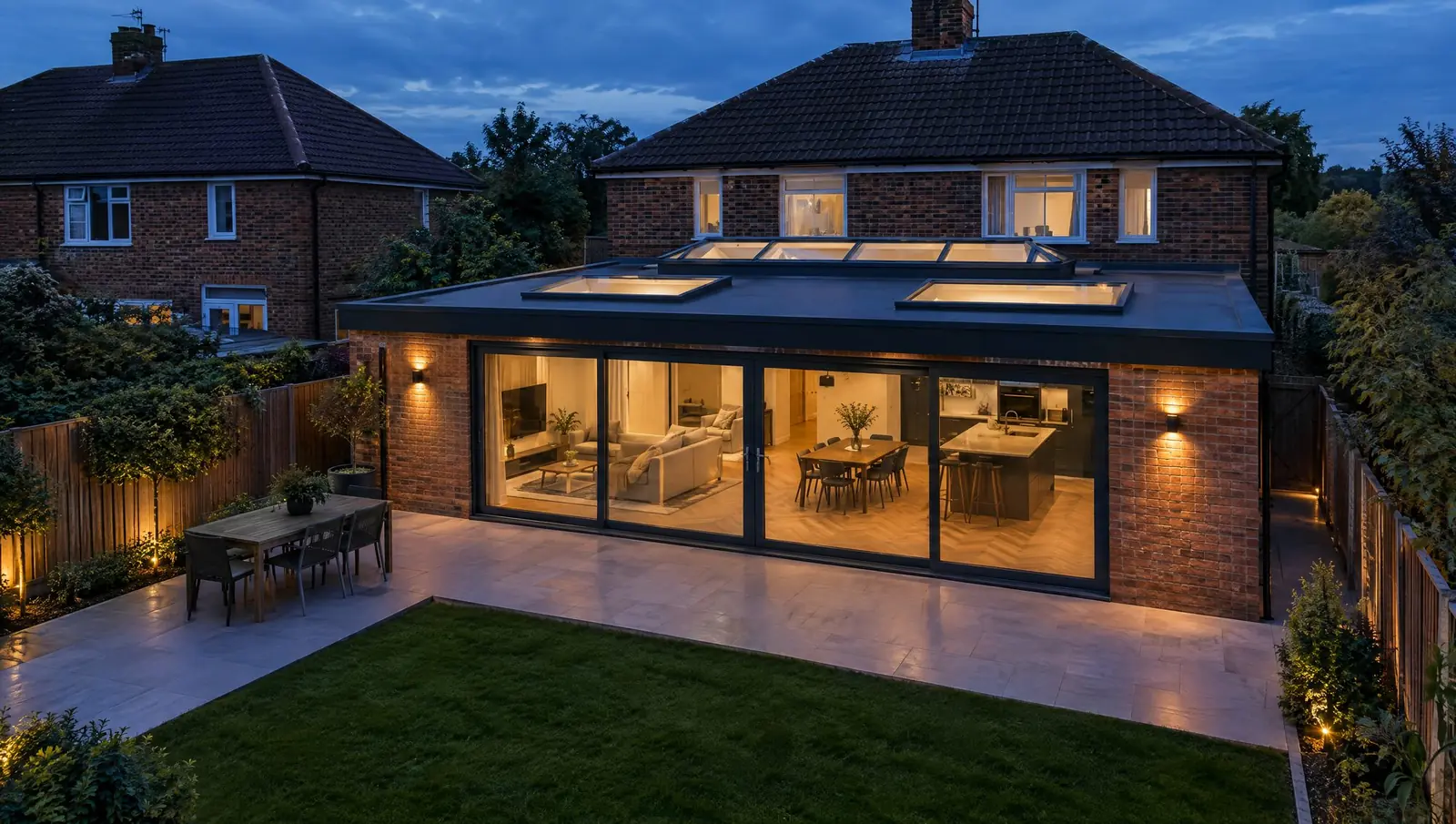
Orangery-style extensions with lanterns are popular across the South East, and solar-control glass makes a big difference on south-facing gardens. Across the South East, single-storey kitchen extensions on 1930s semis and post-war detached houses are where most flat rooflights and lanterns go.
Towns in the Isle of Wight
Options we can specify
- Integral blinds within the glass
- Electric pleated or roller blinds
- Insect screens on opening units
- Solar-powered remote blinds
- Solar-control glass replacement
- Retrofit to most rooflights
- Electric or solar-powered operation
Planning and building rules in England
In England a rooflight on a house is usually permitted development under Class C if it projects no more than 150 mm beyond the roof slope and sits no higher than the ridge. Listed buildings need listed building consent, flats have no householder permitted development rights, and an Article 4 direction can remove the rights in some conservation areas.
Under Approved Document L, a rooflight added to an English home must achieve at least 2.2 W/m²K (horizontal plane), and a roof window 1.4 W/m²K or Window Energy Rating Band B. The Future Homes and Buildings Standards, published in March 2026, apply from 24 March 2027 and keep the 2.2 W/m²K limit for rooflights.
Guide prices
These are typical supply-and-fit ranges. For an address in the Isle of Wight, scaffold, a hoist for heavy glass, or a new structural opening can move the figure, which is why we survey first.
| Option | Guide price inc VAT | Ex VAT |
|---|---|---|
| Integral blind in a new glass unit | £715 – £1,435 | £595 – £1,195 |
| Electric or solar blind Typical | £595 – £1,075 | £495 – £895 |
| Manual pleated or blackout blind | £355 – £595 | £295 – £495 |
How the job runs
- Tell us about the roof. Send the postcode, rough sizes and a photo or two through the form, WhatsApp or the guide-price tool.
- Free survey. For new installations a surveyor measures the opening, checks the roof build-up and talks through glass and options.
- Fixed written quote. You get the product, the work and the price in writing. Nothing is ordered or paid for until you agree.
- Fitting and handover. We fit, seal and make good, then hand over product data, warranties and any certificate paperwork.
Blinds & solar control in nearby areas
Common questions
Can you fit a blind to my existing rooflight?
Usually, yes — if there is enough depth in the reveal for the cassette and rails. We measure first.
Will a blind stop a rooflight getting hot?
An internal blind helps with glare but some heat still gets in behind it. Solar-control glass or an external shade does more for heat.
Can I get full blackout?
Blackout fabrics in side channels give near-total darkness.
Are electric blinds worth it?
For high rooflights you cannot reach, yes. Solar-powered models avoid new wiring.
Will I need planning permission in the Isle of Wight?
English householder permitted development (Class C) normally covers rooflights that stand no more than 0.15 m proud of the roof plane and stay below the highest part of the roof.