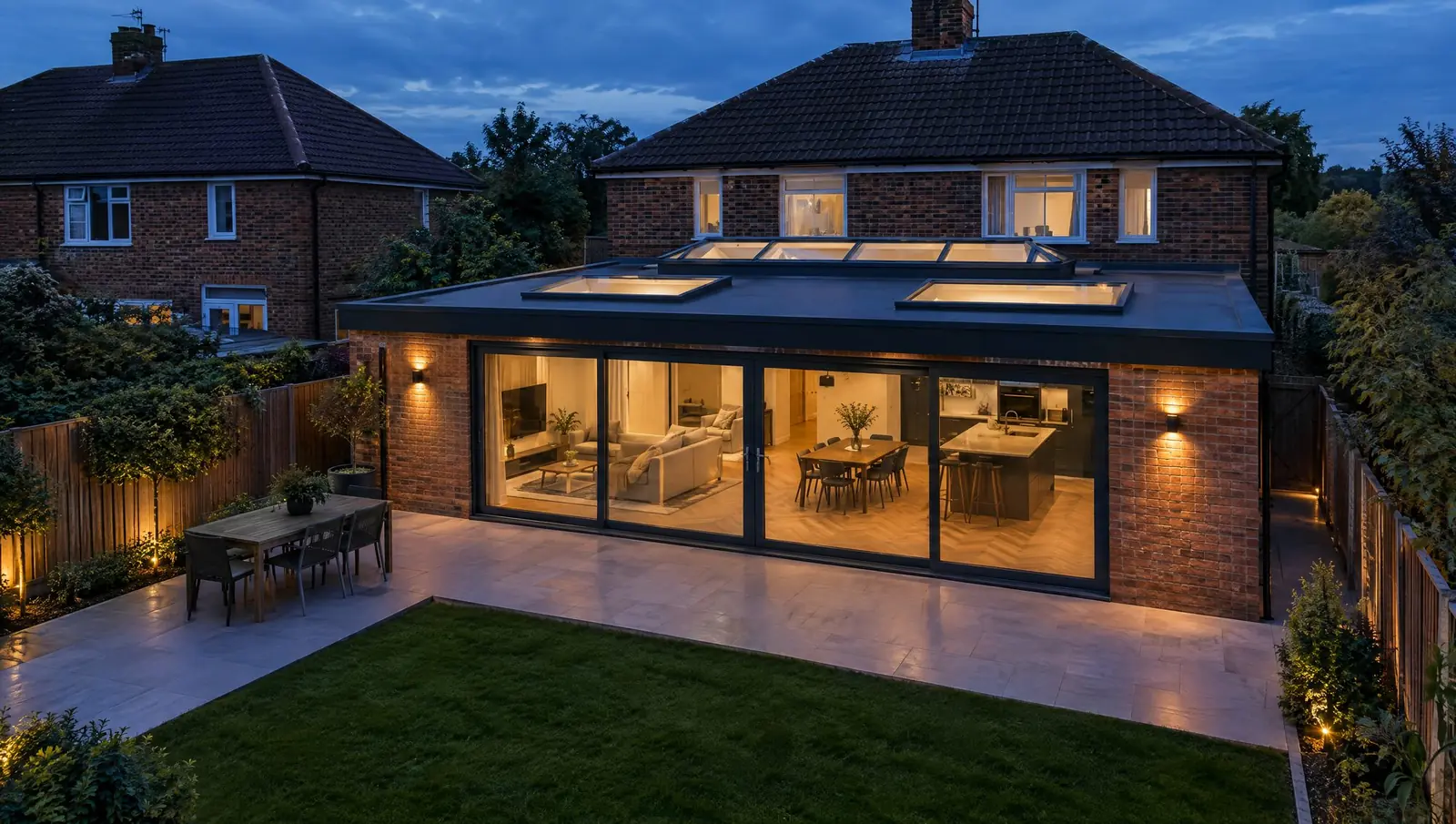
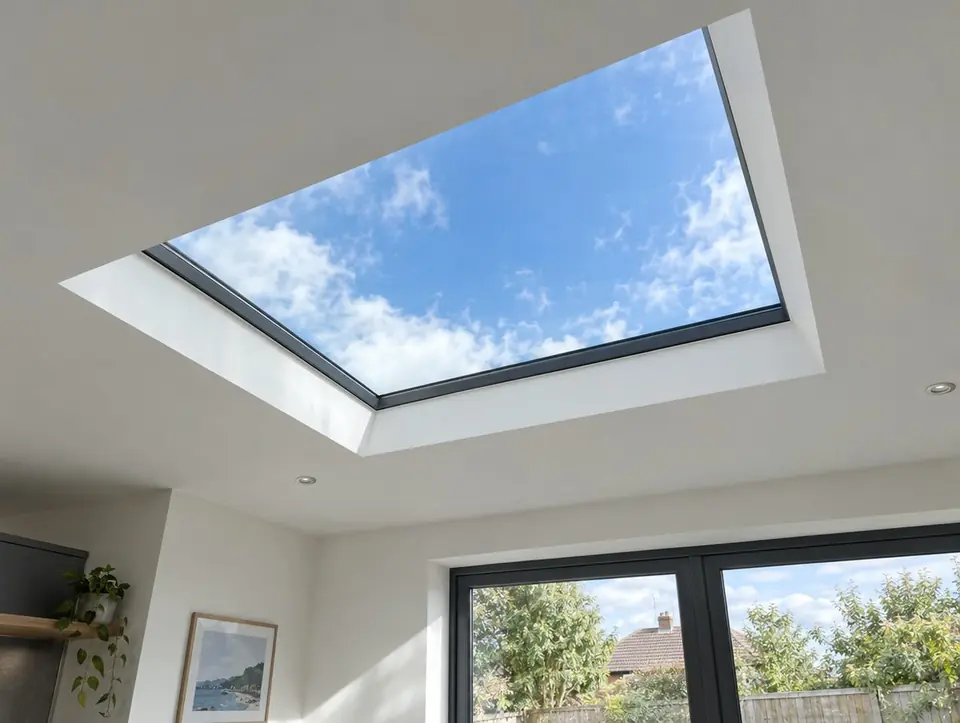
What are flat rooflights?
A flat rooflight is a fixed glazed unit that sits on an upstand on a flat or low-pitched roof, bringing daylight straight down into the room below. Most domestic units are double or triple glazed in a slim aluminium frame, with the glass built to a small fall so rain runs off.
Because light arrives from above, a rooflight usually lights a room more evenly than a wall window of the same size. That is why they are the first choice over kitchen extensions, side returns, landings and windowless bathrooms.
We measure the opening, check the roof build-up and upstand height, and specify a unit that matches the structural opening rather than forcing a stock size into the wrong hole.
- Typical sizes
- 600 × 600 mm up to about 1500 × 3000 mm as a single unit
- Glazing
- Double or triple, toughened outer, laminated inner
- Frame
- Polyester-powder-coated aluminium, thermally broken
- Fall
- Built into the frame or kerb so water sheds
- Fitting time
- Usually one day into a prepared upstand
- Typical lead time
- 2–4 weeks from order for standard sizes
Why choose flat rooflights?
- Even, top-down daylight across the whole room
- Slim sightlines from inside — mostly glass, little frame
- Fixed units are simple, quiet and low-maintenance
- Double or triple glazed with a warm-edge spacer
- Inner pane laminated for safety overhead
- Pairs with an opening unit where you also need ventilation
What options are there?
- Double or triple glazing
- Solar-control or self-cleaning outer pane
- Frame colours: anthracite, black, white or RAL
- Integral or fitted blinds
- Square, rectangular or long-format sizes
- Insulated kerb or timber upstand built to suit
- Plastered or lined internal reveal
- Rain sensor if paired with an opening unit
What should you check before you order?
- Needs a properly formed upstand — usually at least 150 mm above the finished roof surface (check the manufacturer's figure)
- The roof membrane must be dressed up the upstand before the unit goes on
- New openings in an existing roof need a structural check on joists
- Rooflights count toward glazing in an extension, which matters for Building Regulations energy and overheating rules
Planning and building-regulation rules differ between England, Wales, Scotland and Northern Ireland. Our planning guide and building regulations guide set out each nation's position.
How much do flat rooflights cost?
| Option | Guide price inc VAT | Ex VAT |
|---|---|---|
| Large or triple glazed (1500 × 2500 mm and up) | £2,395 – £4,195 | £1,995 – £3,495 |
| Mid-size double glazed (1000 × 2000 mm) Typical | £1,675 – £2,395 | £1,395 – £1,995 |
| Small double glazed (up to 1000 × 1000 mm) | £1,195 – £1,795 | £995 – £1,495 |
Guide prices per rooflight, supplied and fitted into a prepared opening. Your fixed price follows a free survey for new installations.
Flat rooflights: common questions
Do flat rooflights leak?
A well-fitted flat rooflight should not leak. Leaks almost always come from the upstand or membrane detailing, not the glass unit, which is why the upstand height and the way the roof covering is dressed up and under the frame matter more than the brand.
Can a flat rooflight be walked on?
Not unless it is designed as a walk-on unit with structural laminated glass. A standard flat rooflight is for light only — if the roof is used as a terrace, choose a walk-on rooflight instead.
Double or triple glazing?
Double glazing suits most domestic jobs. Triple glazing improves thermal performance and cuts noise from rain, which is worth it over bedrooms or where the energy calculation is tight.
Will it make the room too hot?
A big unglazed-to-sky area can add solar gain in summer. Solar-control glass, a blind, or pairing a fixed unit with an opening one keeps it comfortable.
Can you fit into my existing flat roof?
Yes. We form a new opening, trim the joists, build and waterproof an upstand and make good the ceiling. A survey confirms the joist direction and roof build-up first.
How long does it take?
Fitting into a prepared upstand usually takes a day. Forming a new opening in an existing roof, including making good inside, is often two to three days.