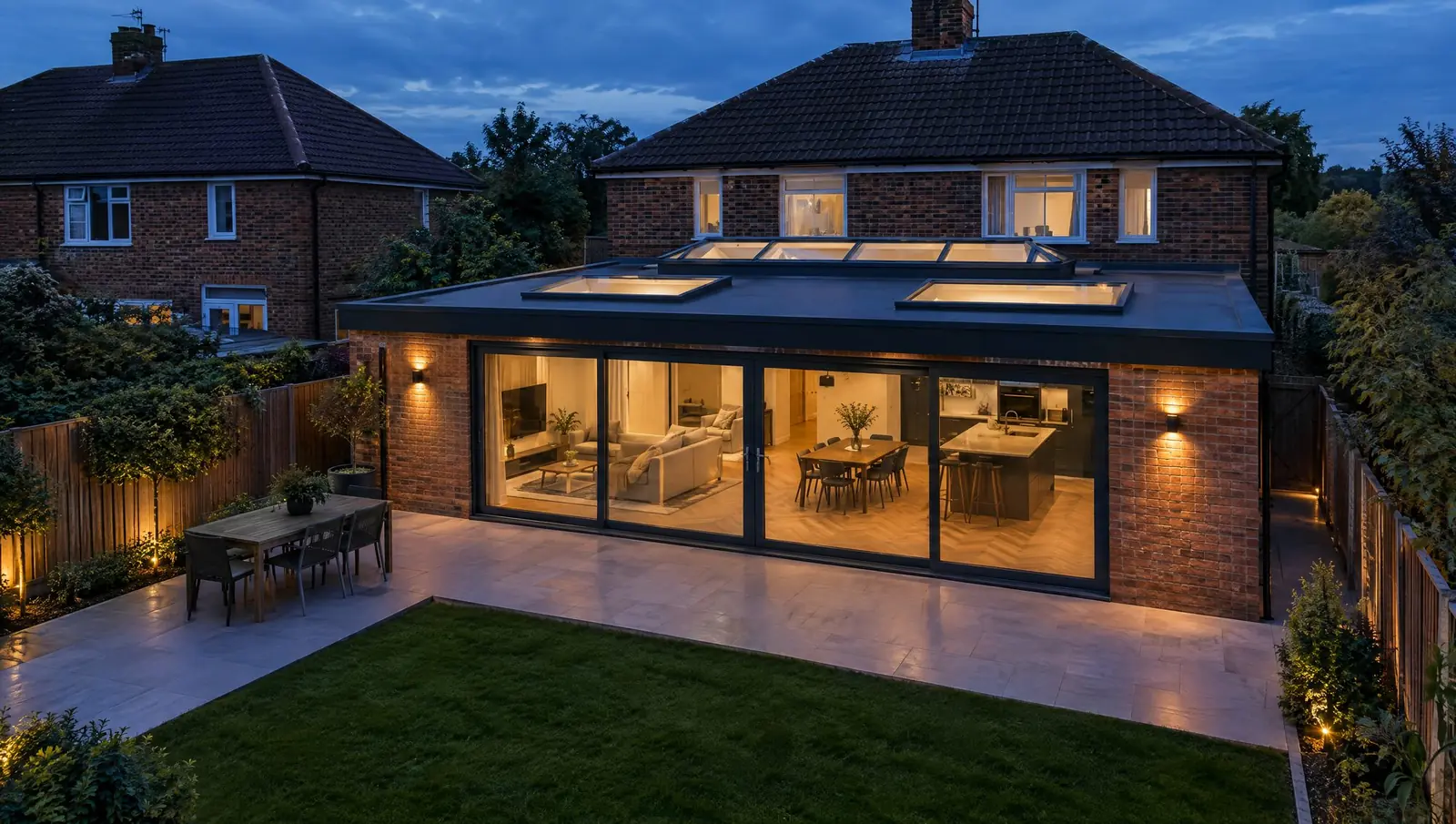
A new or replacement rooflight in an existing English home must achieve a U-value of 2.2 W/m²K or better (measured horizontally), and a roof window 1.4 W/m²K or Window Energy Rating Band B. Extensions normally limit glazing, rooflights included, to 25% of the new floor area. Wales, Scotland and Northern Ireland have their own figures.
What U-value does a rooflight need?
Building Regulations Approved Document L sets a limiting U-value of 2.2 W/m²K for new or replacement rooflights in existing homes, measured in the horizontal plane; roof windows need 1.4 W/m²K or a Band B energy rating.
Rooflight U-values are quoted in the horizontal plane in England and Wales, because a rooflight lies flat. A roof window is assessed in the vertical position. Northern Ireland assesses rooflights in the vertical position too, so manufacturer data must be read for the right plane.
Is there a limit on glazing in an extension?
In England, guidance limits the total glazing in an extension — windows, doors, roof windows and rooflights — to 25% of the extension's floor area, plus the area of any windows or doors it covers over. A larger area is possible if a whole-dwelling energy calculation shows the house performs no worse. Scotland and Northern Ireland use a similar 25% allowance.
Does an opening rooflight count as purge ventilation?
Approved Document F accepts hinged or pivot openings for purge ventilation. An opening that swings 30° or more needs an area of at least 1/20 of the room's floor area; between 15° and 30° it needs 1/10. Many electric rooflights open to a limited angle, so check the manufacturer's free-area figure.
Do walk-on and roof terrace rooflights need guarding?
Approved Document K expects guarding where people could fall from a roof that they can reach, including around rooflights and openings. Separately, HSE advises treating every roof and rooflight as fragile until a competent person confirms otherwise. Non-fragile is not the same as walk-on — only a unit designed for foot traffic should be stood on.
What about fire?
Rooflights form part of the roof covering under Approved Document B, so their external fire classification matters where they are close to a boundary or a compartment wall. Plastic rooflights are classified separately and some are limited in area. Manufacturers publish the classification for each product.
Who signs off the work?
In England and Wales, replacing a rooflight or roof window can be self-certified by an installer registered with an authorised competent person scheme; a new opening, structural alteration or extension goes through building control. In Scotland, replacing a rooflight with its frame needs no building warrant but must still meet the standards, and new openings are checked with the local authority verifier. In Northern Ireland, check with council building control. We tell you which route your job needs before work starts.
Is the Future Homes Standard changing the rules?
The Future Homes and Buildings Standards, published in March 2026, apply from 24 March 2027 and keep the 2.2 W/m²K limit for rooflights.
How do Wales, Scotland and Northern Ireland differ?
Approved Document L in Wales (2022 edition) sets 2.2 W/m²K for rooflights, measured horizontally, and 1.4 W/m²K or Band B for roof windows in existing homes. Wales also has its own overheating rules (Part O) for new homes, in force since November 2022.
Scotland's Technical Handbook (section 6) asks for windows, doors and rooflights in an extension to average 1.4–1.6 W/m²K, with no single unit worse than 3.3 W/m²K. Replacing a rooflight, frame included, does not need a building warrant, but the work must still meet the building standards.
Technical Booklet F1 (2022) asks for replacement windows and rooflights in existing homes to reach WER Band C or a U-value of 1.6 W/m²K, assessed in the vertical position. Extensions follow a 25% glazing allowance in Technical Booklet F1.
This guide gives general information, not legal or structural advice. Rules change and every property is different — check with your council or building control for your address. We review our guides regularly; the date above shows the last review.
Sources
- Approved Document L, Volume 1 (2021 incorporating 2023 amendments)
- The Future Homes and Buildings Standards: Building Circular 01/2026
- GPDO 2015, Schedule 2 Part 1 Class C (England)
- Permitted development rights for householders: technical guidance
- Approved Document L Volume 1, Wales (2022 incorporating 2024 amendments)
- Town and Country Planning (GPDO) (Amendment) (Wales) Order 2013
- Building Standards Technical Handbook 2022: Domestic, section 6
- Circular 1/2024: householder permitted development rights (Scotland)
- Technical Booklet F1 (Northern Ireland), June 2022
- Planning (General Permitted Development) Order (NI) 2015, Schedule Part 1
- Building Regulations 2010, Schedule 3 (competent person self-certification)
- Approved Document F, Volume 1
- Approved Document O: overheating FAQs
- Approved Document K
- HSE: fragile roofs
- Regulatory Reform (Fire Safety) Order 2005, article 17
Find this useful? Add SkylightCompany.uk as a preferred source on Google.