Electric opening rooflights in Notting Hill: what is involved?
Electric opening rooflights in Notting Hill means hinged rooflights that open on an electric actuator for fresh air. We cover the W11 district and the rest of Greater London, with a survey before any price is fixed.
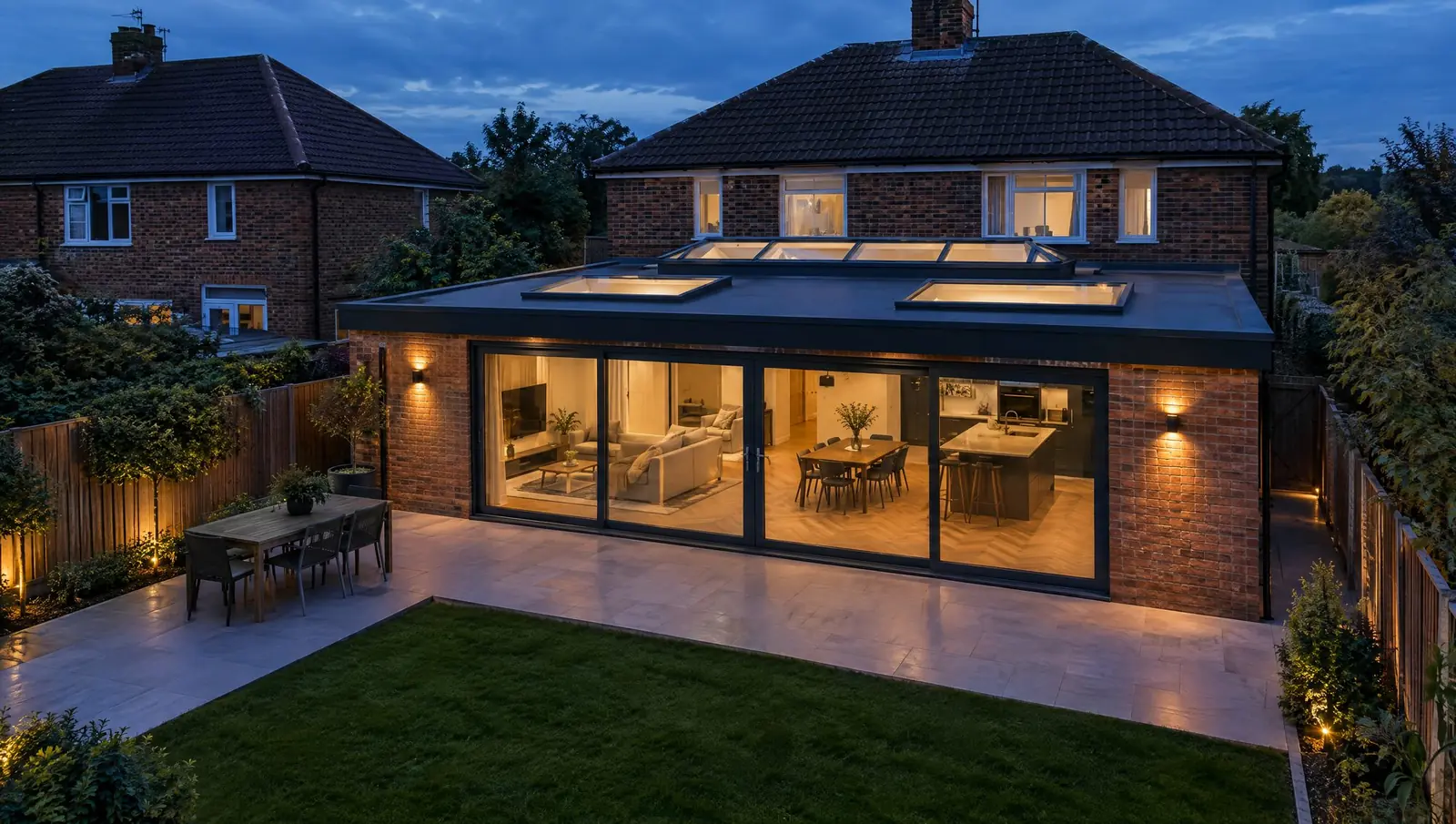
Victorian and Edwardian terraces with narrow side returns are typical of much of London, and a glass roof or long flat rooflight is the usual way to keep the back rooms bright once the return is built over. Typical uses for electric opening rooflights include rooms that overheat in summer or steam up when cooking.
We work across Greater London, including Notting Hill, and in neighbouring towns such as Shepherds Bush and Kensington. Access, parking and how the glass reaches the roof are all checked at the survey.
Specification options
- Rain and wind sensor
- Manual winder on smaller units
- Frame colour to match your doors
- Integral blind
- Double or triple glazing
- Same slim look as a fixed unit when closed
- Can be grouped with fixed units on one roof
Things we check at survey
- Electrical connection should be made by a competent electrician to BS 7671
- Opening area may count toward purge ventilation for the room
Planning, building control and Notting Hill
In England a rooflight on a house is usually permitted development under Class C if it projects no more than 150 mm beyond the roof slope and sits no higher than the ridge. A rooflight on a side-facing slope must be obscure-glazed, and fixed shut unless the opening part is more than 1.7 m above the floor.
Under Approved Document L, a rooflight added to an English home must achieve at least 2.2 W/m²K (horizontal plane), and a roof window 1.4 W/m²K or Window Energy Rating Band B. The Future Homes and Buildings Standards, published in March 2026, apply from 24 March 2027 and keep the 2.2 W/m²K limit for rooflights.
See our building regulations guide for U-values, glazing limits and self-certification.
Electric opening rooflights prices in Notting Hill
Guide prices for electric opening rooflights in Notting Hill are the same as anywhere we work — what changes the price is the job: access, structure, scaffold and finishing.
| Option | Guide price inc VAT | Ex VAT |
|---|---|---|
| Large with rain sensor and blind | £4,195 – £5,995 | £3,495 – £4,995 |
| Mid-size electric with rain sensor Typical | £2,995 – £4,195 | £2,495 – £3,495 |
| Small manual or electric opening unit | £2,395 – £3,115 | £1,995 – £2,595 |
What happens next
- Tell us what you have. Send the W11 postcode, a rough size and a couple of photos.
- Measure and check. A surveyor visits Notting Hill, measures and checks structure and access.
- Agree the quote. You approve the specification and price before anything is ordered.
- Fit and make good. We fit, seal, test and finish the reveal, then hand over the paperwork.
Neighbouring towns
More we do in Notting Hill
Common questions
What happens if it rains while it is open?
With a rain sensor fitted, the actuator closes the lid automatically when the sensor detects water. Without one, the lid stays where you left it, which is why we recommend the sensor on any unit over a kitchen or bedroom.
Can I control it from my phone?
Some ranges link to smart-home hubs or their own app. If that matters, say so at survey and we will specify a compatible model.
Is it secure when open?
An opening rooflight is a vent, not an access hatch, so the gap is small. For security, close it when the house is empty — a rain sensor does not lock the unit.
How do I book a survey in Notting Hill?
Send your postcode and, if you can, a photo of the roof and the room. We offer a survey date when we reply.
Will I need planning permission in Notting Hill?
English householder permitted development (Class C) normally covers rooflights that stand no more than 0.15 m proud of the roof plane and stay below the highest part of the roof.