How we approach flat rooflights in London
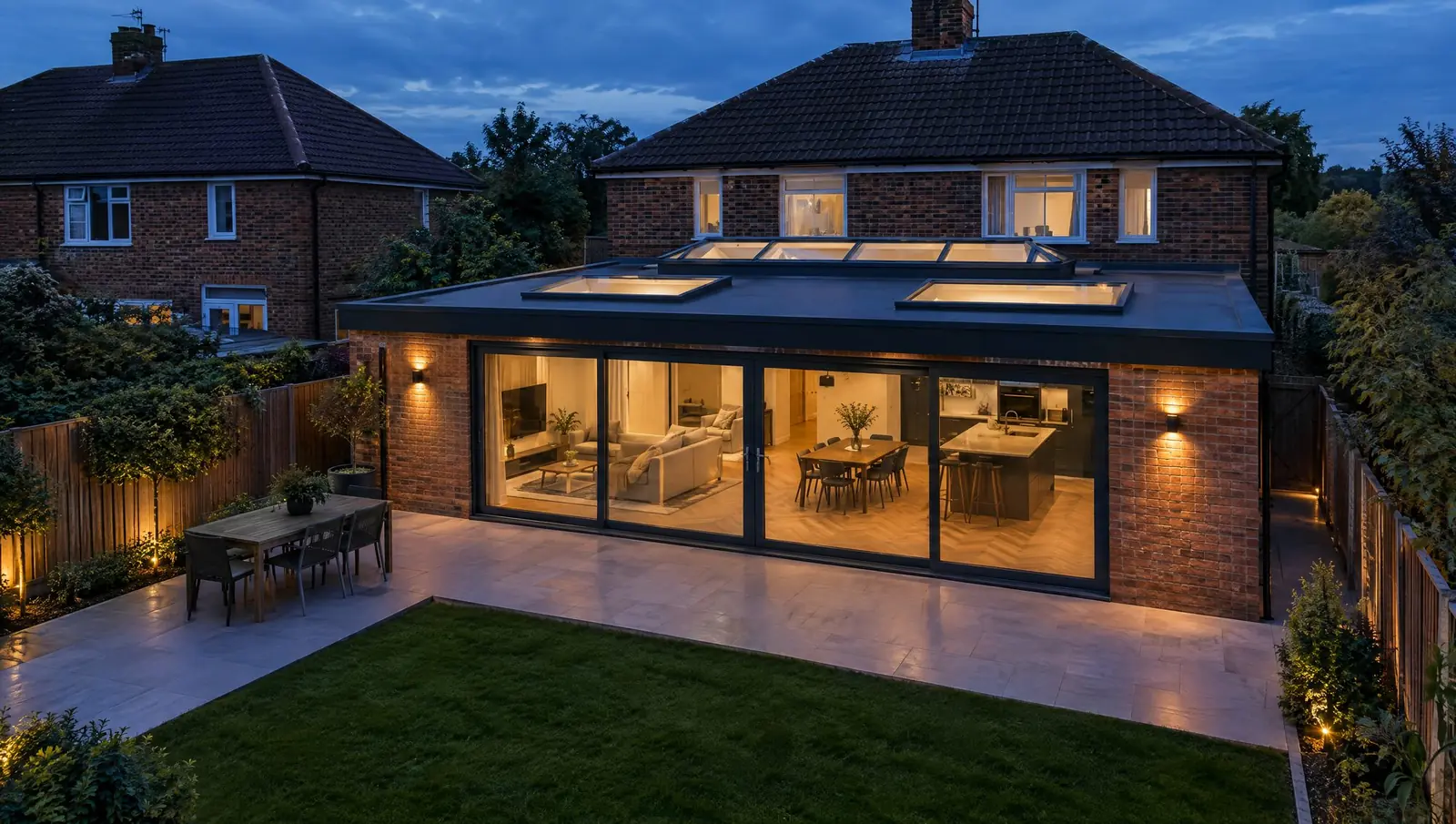
For London homes and buildings we offer flat rooflights: fixed double or triple glazed rooflights for flat roofs and extensions. We measure first, specify to the opening and confirm any planning or building-control points before quoting.
Party walls are a fact of life in London terraces, and rooflights close to a shared wall need detailing that keeps the neighbour's side dry too. Typical uses for flat rooflights include kitchen extensions, side returns and flat-roofed back rooms.
London is the main town we list in Greater London; we also cover nearby Pimlico and Islington.
Options we can specify in London
- Solar-control or self-cleaning outer pane
- Square, rectangular or long-format sizes
- Double or triple glazing
- Plastered or lined internal reveal
- Frame colours: anthracite, black, white or RAL
- Double or triple glazed with a warm-edge spacer
- Fixed units are simple, quiet and low-maintenance
What to check first
- The roof membrane must be dressed up the upstand before the unit goes on
- Needs a properly formed upstand — usually at least 150 mm above the finished roof surface (check the manufacturer's figure)
Consents for flat rooflights in London
In England a rooflight on a house is usually permitted development under Class C if it projects no more than 150 mm beyond the roof slope and sits no higher than the ridge. Listed buildings need listed building consent, flats have no householder permitted development rights, and an Article 4 direction can remove the rights in some conservation areas.
Building Regulations Approved Document L sets a limiting U-value of 2.2 W/m²K for new or replacement rooflights in existing homes, measured in the horizontal plane; roof windows need 1.4 W/m²K or a Band B energy rating. The Future Homes and Buildings Standards, published in March 2026, apply from 24 March 2027 and keep the 2.2 W/m²K limit for rooflights.
Our planning guide covers each nation in more detail.
Guide prices for London
The ranges below are typical for straightforward jobs; your fixed price follows a survey of your roof.
| Option | Guide price inc VAT | Ex VAT |
|---|---|---|
| Large or triple glazed (1500 × 2500 mm and up) | £2,395 – £4,195 | £1,995 – £3,495 |
| Mid-size double glazed (1000 × 2000 mm) Typical | £1,675 – £2,395 | £1,395 – £1,995 |
| Small double glazed (up to 1000 × 1000 mm) | £1,195 – £1,795 | £995 – £1,495 |
The process, step by step
- Get in touch. Use the form, WhatsApp or the guide-price tool with your London address.
- Survey. We measure the opening, check the roof build-up and agree the options.
- Fixed quote. Product, work and price in writing — nothing is ordered until you agree.
- Fit and make good. We fit, seal, test and finish the reveal, then hand over the paperwork.
Neighbouring towns
More we do in London
Common questions
Double or triple glazing?
Double glazing suits most domestic jobs. Triple glazing improves thermal performance and cuts noise from rain, which is worth it over bedrooms or where the energy calculation is tight.
How long does it take?
Fitting into a prepared upstand usually takes a day. Forming a new opening in an existing roof, including making good inside, is often two to three days.
Will it make the room too hot?
A big unglazed-to-sky area can add solar gain in summer. Solar-control glass, a blind, or pairing a fixed unit with an opening one keeps it comfortable.
How do I book a survey in London?
Send your postcode and, if you can, a photo of the roof and the room. We offer a survey date when we reply.
Is the survey in London free?
Yes for new installations. Repair visits are charged, and we tell you the price before we book.