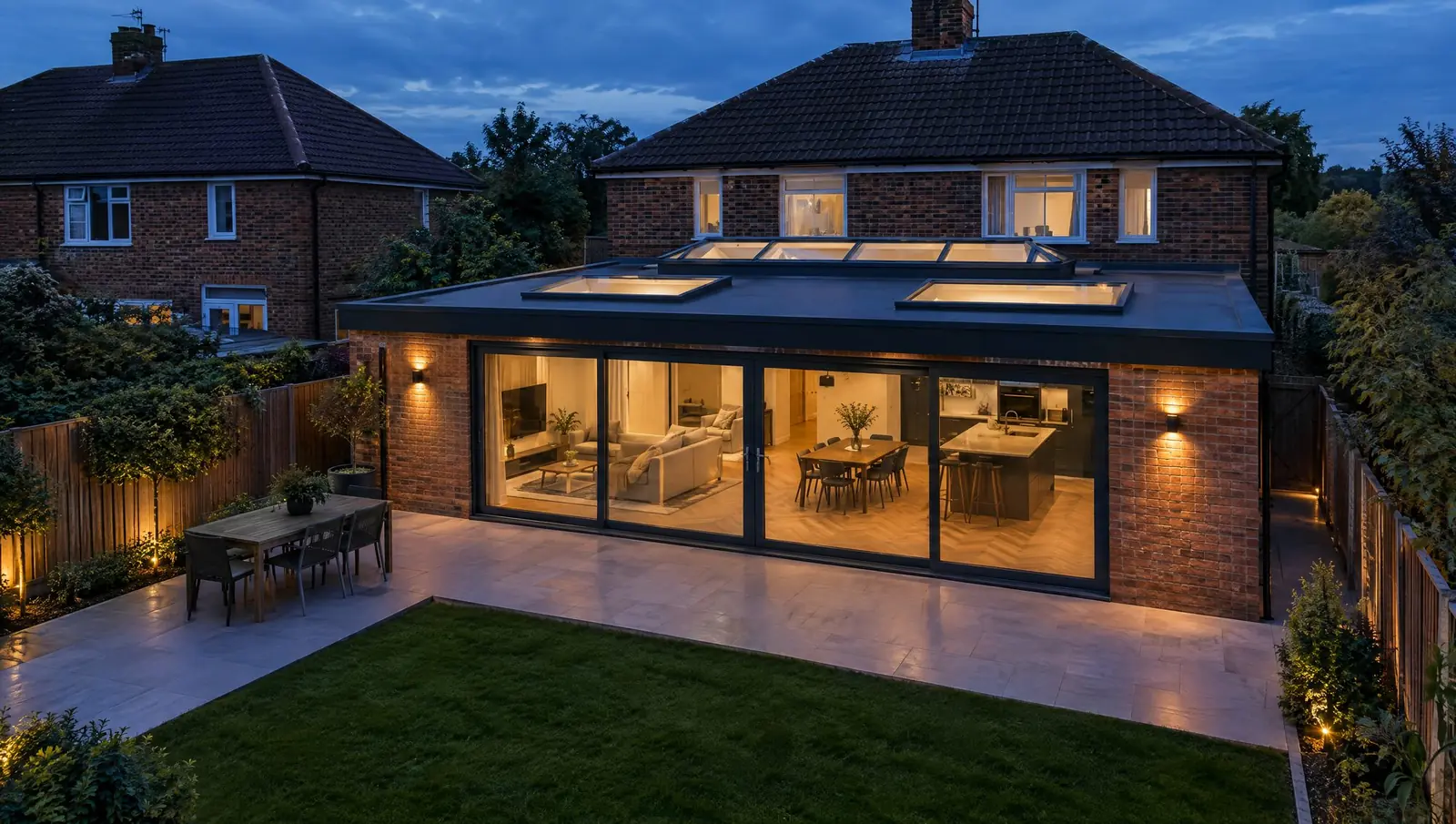
What do flat rooflights in Ashton-under-Lyne involve?
Flat rooflights in Ashton-under-Lyne means fixed double or triple glazed rooflights for flat roofs and extensions. We cover the OL7 district and the rest of Greater Manchester, with a survey before any price is fixed.
The North West gets more rain than most of England, so upstand height, membrane detailing and rain sensors on opening units are not optional extras. Flat rooflights suit kitchen extensions, side returns and flat-roofed back rooms.
We work across Greater Manchester, including Ashton-under-Lyne, and in neighbouring towns such as Dukinfield and Stalybridge. Access, parking and how the glass reaches the roof are all checked at the survey.
Choices for your Ashton-under-Lyne project
- Double or triple glazing
- Rain sensor if paired with an opening unit
- Solar-control or self-cleaning outer pane
- Frame colours: anthracite, black, white or RAL
- Integral or fitted blinds
- Slim sightlines from inside — mostly glass, little frame
- Even, top-down daylight across the whole room
Things we check at survey
- Needs a properly formed upstand — usually at least 150 mm above the finished roof surface (check the manufacturer's figure)
- Rooflights count toward glazing in an extension, which matters for Building Regulations energy and overheating rules
Planning and building rules for Ashton-under-Lyne
Most rooflights on English houses do not need planning permission, provided they keep within 150 mm of the roof surface and below the ridge line. A rooflight on a side-facing slope must be obscure-glazed, and fixed shut unless the opening part is more than 1.7 m above the floor.
Building Regulations Approved Document L sets a limiting U-value of 2.2 W/m²K for new or replacement rooflights in existing homes, measured in the horizontal plane; roof windows need 1.4 W/m²K or a Band B energy rating. The Future Homes and Buildings Standards, published in March 2026, apply from 24 March 2027 and keep the 2.2 W/m²K limit for rooflights.
Read the planning permission guide before you commit to a design.
What do flat rooflights cost in Ashton-under-Lyne?
These are typical supply-and-fit ranges. For an address in Ashton-under-Lyne, scaffold, a hoist for heavy glass, or a new structural opening can move the figure, which is why we survey first.
| Option | Guide price inc VAT | Ex VAT |
|---|---|---|
| Large or triple glazed (1500 × 2500 mm and up) | £2,395 – £4,195 | £1,995 – £3,495 |
| Mid-size double glazed (1000 × 2000 mm) Typical | £1,675 – £2,395 | £1,395 – £1,995 |
| Small double glazed (up to 1000 × 1000 mm) | £1,195 – £1,795 | £995 – £1,495 |
From enquiry to finished job
- Tell us what you have. Send the OL7 postcode, a rough size and a couple of photos.
- Survey. We measure the opening, check the roof build-up and agree the options.
- Agree the quote. You approve the specification and price before anything is ordered.
- Fitting and handover. We install, clean down and leave product and warranty documents.
Nearby towns
Other services in Ashton-under-Lyne
Flat rooflights in Ashton-under-Lyne: questions
Do flat rooflights leak?
A well-fitted flat rooflight should not leak. Leaks almost always come from the upstand or membrane detailing, not the glass unit, which is why the upstand height and the way the roof covering is dressed up and under the frame matter more than the brand.
Double or triple glazing?
Double glazing suits most domestic jobs. Triple glazing improves thermal performance and cuts noise from rain, which is worth it over bedrooms or where the energy calculation is tight.
Can a flat rooflight be walked on?
Not unless it is designed as a walk-on unit with structural laminated glass. A standard flat rooflight is for light only — if the roof is used as a terrace, choose a walk-on rooflight instead.
Do you fit flat rooflights in Ashton-under-Lyne?
Yes. We survey and fit flat rooflights in Ashton-under-Lyne and across Greater Manchester. Send your postcode and we will offer a survey date when we reply.
Do I need to be at home for the survey in Ashton-under-Lyne?
Yes — someone needs to let us into the room below and, where possible, show us how the roof is reached.