Flat rooflights for Newcastle-under-Lyme: the essentials
We handle flat rooflights across Staffordshire, including Newcastle-under-Lyme. In short: fixed double or triple glazed rooflights for flat roofs and extensions. The survey checks structure, weathering and orientation, so the quote reflects your actual roof.
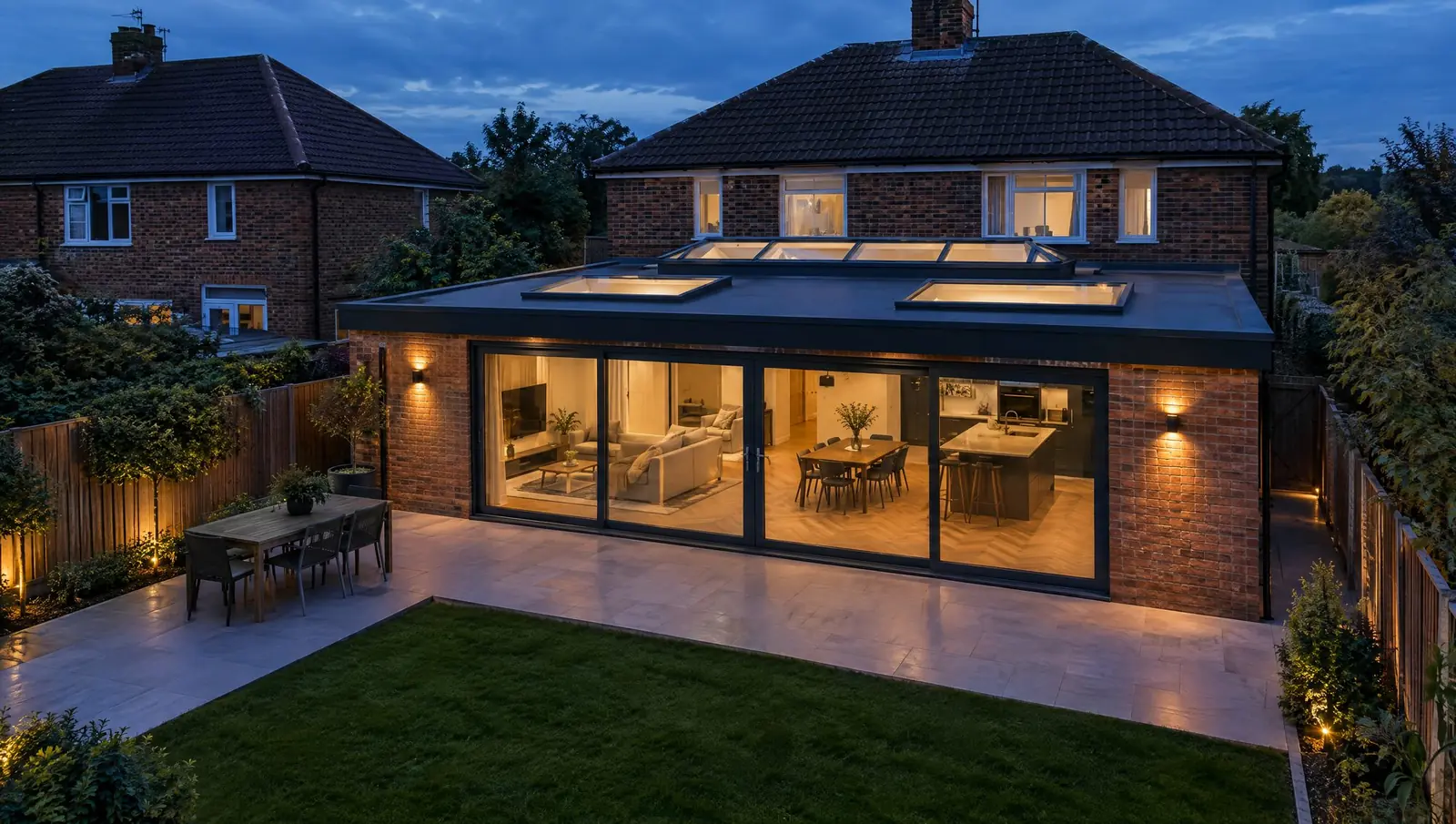
Bungalows are common across parts of the Midlands, and sun tunnels or roof windows are a quick way to brighten internal hallways. Think of flat rooflights for kitchen extensions, side returns and flat-roofed back rooms.
Jobs in Newcastle-under-Lyme are planned around access: whether the roof can be reached from the garden, whether a hoist or crane is needed, and where we can park. We check this when we measure.
Choices for your Newcastle-under-Lyme project
- Solar-control or self-cleaning outer pane
- Frame colours: anthracite, black, white or RAL
- Integral or fitted blinds
- Plastered or lined internal reveal
- Square, rectangular or long-format sizes
- Even, top-down daylight across the whole room
- Fixed units are simple, quiet and low-maintenance
What to check first
- New openings in an existing roof need a structural check on joists
- Rooflights count toward glazing in an extension, which matters for Building Regulations energy and overheating rules
Planning, building control and Newcastle-under-Lyme
In England a rooflight on a house is usually permitted development under Class C if it projects no more than 150 mm beyond the roof slope and sits no higher than the ridge. Listed buildings need listed building consent, flats have no householder permitted development rights, and an Article 4 direction can remove the rights in some conservation areas.
For English homes the energy rules ask for rooflights of 2.2 W/m²K or better and roof windows of 1.4 W/m²K (or WER Band B); most modern double glazed units meet both. The Future Homes and Buildings Standards, published in March 2026, apply from 24 March 2027 and keep the 2.2 W/m²K limit for rooflights.
Our planning guide covers each nation in more detail.
Guide prices for Newcastle-under-Lyme
Guide prices for flat rooflights in Newcastle-under-Lyme are the same as anywhere we work — what changes the price is the job: access, structure, scaffold and finishing.
| Option | Guide price inc VAT | Ex VAT |
|---|---|---|
| Large or triple glazed (1500 × 2500 mm and up) | £2,395 – £4,195 | £1,995 – £3,495 |
| Mid-size double glazed (1000 × 2000 mm) Typical | £1,675 – £2,395 | £1,395 – £1,995 |
| Small double glazed (up to 1000 × 1000 mm) | £1,195 – £1,795 | £995 – £1,495 |
What happens next
- Send the details. Postcode, rough size and a photo of the roof and room.
- Survey. We measure the opening, check the roof build-up and agree the options.
- Written price. You receive a fixed price listing the unit, the work and the lead time.
- Fitting and handover. We install, clean down and leave product and warranty documents.
Neighbouring towns
Related work in Newcastle-under-Lyme
Flat rooflights in Newcastle-under-Lyme: questions
Can a flat rooflight be walked on?
Not unless it is designed as a walk-on unit with structural laminated glass. A standard flat rooflight is for light only — if the roof is used as a terrace, choose a walk-on rooflight instead.
Will it make the room too hot?
A big unglazed-to-sky area can add solar gain in summer. Solar-control glass, a blind, or pairing a fixed unit with an opening one keeps it comfortable.
Do flat rooflights leak?
A well-fitted flat rooflight should not leak. Leaks almost always come from the upstand or membrane detailing, not the glass unit, which is why the upstand height and the way the roof covering is dressed up and under the frame matter more than the brand.
Do you fit flat rooflights in Newcastle-under-Lyme?
Yes. We survey and fit flat rooflights in Newcastle-under-Lyme and across Staffordshire. Send your postcode and we will offer a survey date when we reply.
Will I need planning permission in Newcastle-under-Lyme?
English householder permitted development (Class C) normally covers rooflights that stand no more than 0.15 m proud of the roof plane and stay below the highest part of the roof.