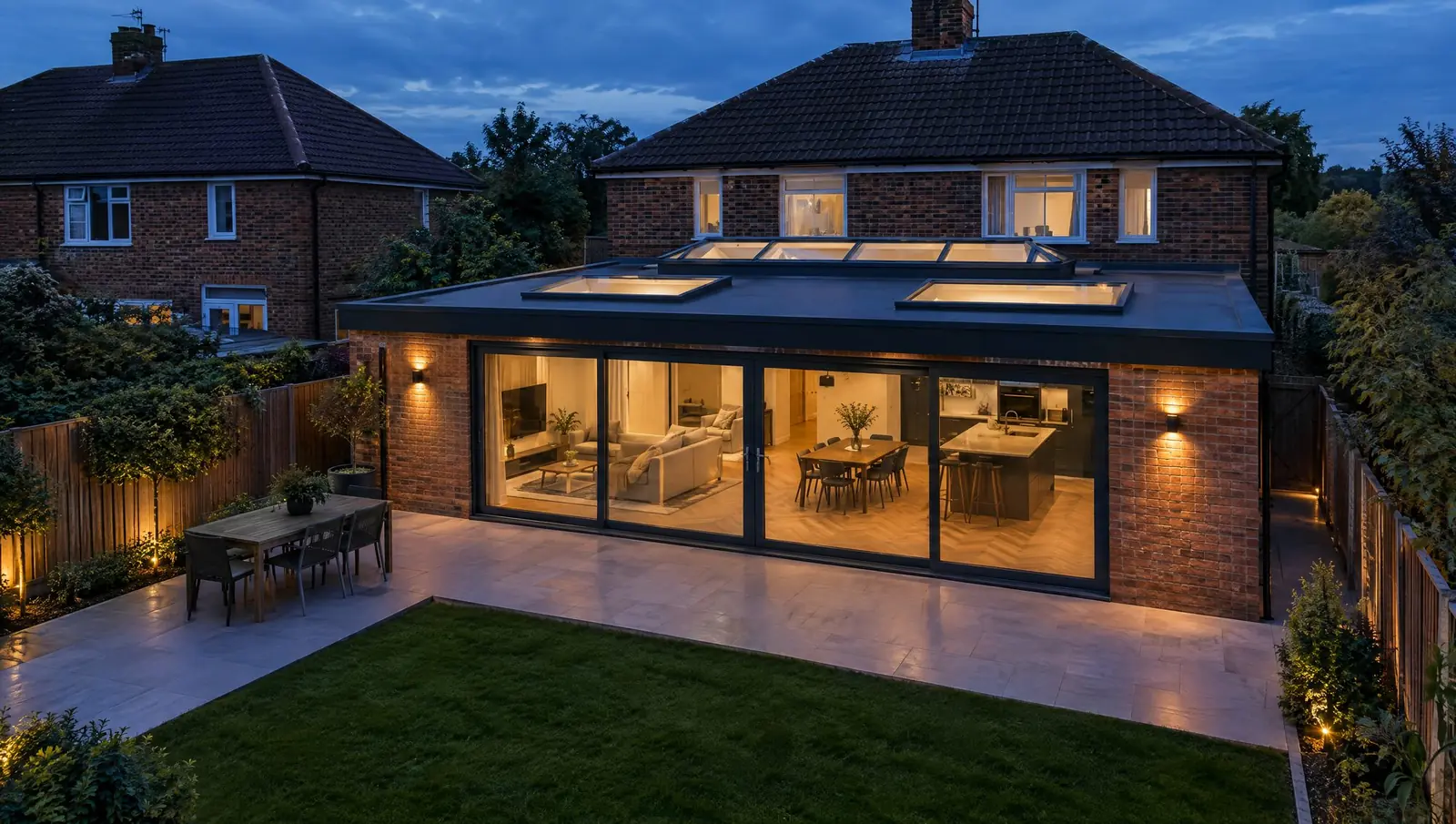
How we approach rooflight upstands & kerbs in March
Thinking about rooflight upstands & kerbs in March? The short answer: insulated kerbs built and waterproofed to suit your rooflight. The longer answer depends on your roof, which is why we survey before we price.
Barn conversions and timber-framed homes across the East often call for conservation rooflights or bespoke glass. Rooflight upstands & kerbs suit roofs where the old kerb is low, cold or leaking.
Neighbouring towns include Wisbech (14 km) and Ely (21 km). We offer a survey date when we reply to your enquiry.
What you can choose
- Upstand repairs and rebuilds
- Raised upstands for deep green or ballasted roofs
- Internal plaster-box linings
- Upstands to suit single-ply, felt, GRP or liquid roofs
- Timber upstands with insulation
- Correct height above the finished roof
- Insulated to avoid a cold bridge
Things we check at survey
- Membrane compatibility with the rooflight's sealants
- Minimum upstand height is set by the rooflight manufacturer — commonly 150 mm above the finished roof
Planning and building rules for March
In England a rooflight on a house is usually permitted development under Class C if it projects no more than 150 mm beyond the roof slope and sits no higher than the ridge. A rooflight on a side-facing slope must be obscure-glazed, and fixed shut unless the opening part is more than 1.7 m above the floor.
For English homes the energy rules ask for rooflights of 2.2 W/m²K or better and roof windows of 1.4 W/m²K (or WER Band B); most modern double glazed units meet both. In an extension, glazing including rooflights is normally limited to 25% of the new floor area plus any windows or doors the extension covers, unless a whole-house calculation shows otherwise.
Read the planning permission guide before you commit to a design.
What do rooflight upstands & kerbs cost in March?
These are typical supply-and-fit ranges. For an address in March, scaffold, a hoist for heavy glass, or a new structural opening can move the figure, which is why we survey first.
| Option | Guide price inc VAT | Ex VAT |
|---|---|---|
| Large or raised upstand | £715 – £1,195 | £595 – £995 |
| Standard insulated upstand Typical | £475 – £715 | £395 – £595 |
| Small upstand on new roof | £355 – £475 | £295 – £395 |
The process, step by step
- Send the details. Postcode, rough size and a photo of the roof and room.
- Free site visit. For new installs we survey free, measure and confirm the roof detail.
- Agree the quote. You approve the specification and price before anything is ordered.
- Fitting and handover. We install, clean down and leave product and warranty documents.
Rooflight upstands & kerbs near March
Related work in March
Questions about rooflight upstands & kerbs in March
How high should a rooflight upstand be?
High enough to meet the rooflight manufacturer's minimum above the finished roof surface — commonly 150 mm. On roofs with deep finishes, such as green roofs, it needs to be taller.
Why is my rooflight cold around the edge?
Usually an uninsulated upstand. Insulating the kerb and lining the reveal fixes most cold spots.
Can an old upstand be reused?
If it is sound, square, insulated and the right size. Often it is cheaper to rebuild than adapt.
Can you work alongside my builder in March?
Yes. On new extensions we fit once the opening and upstand are ready and coordinate dates with your builder.
Will I need planning permission in March?
English householder permitted development (Class C) normally covers rooflights that stand no more than 0.15 m proud of the roof plane and stay below the highest part of the roof.