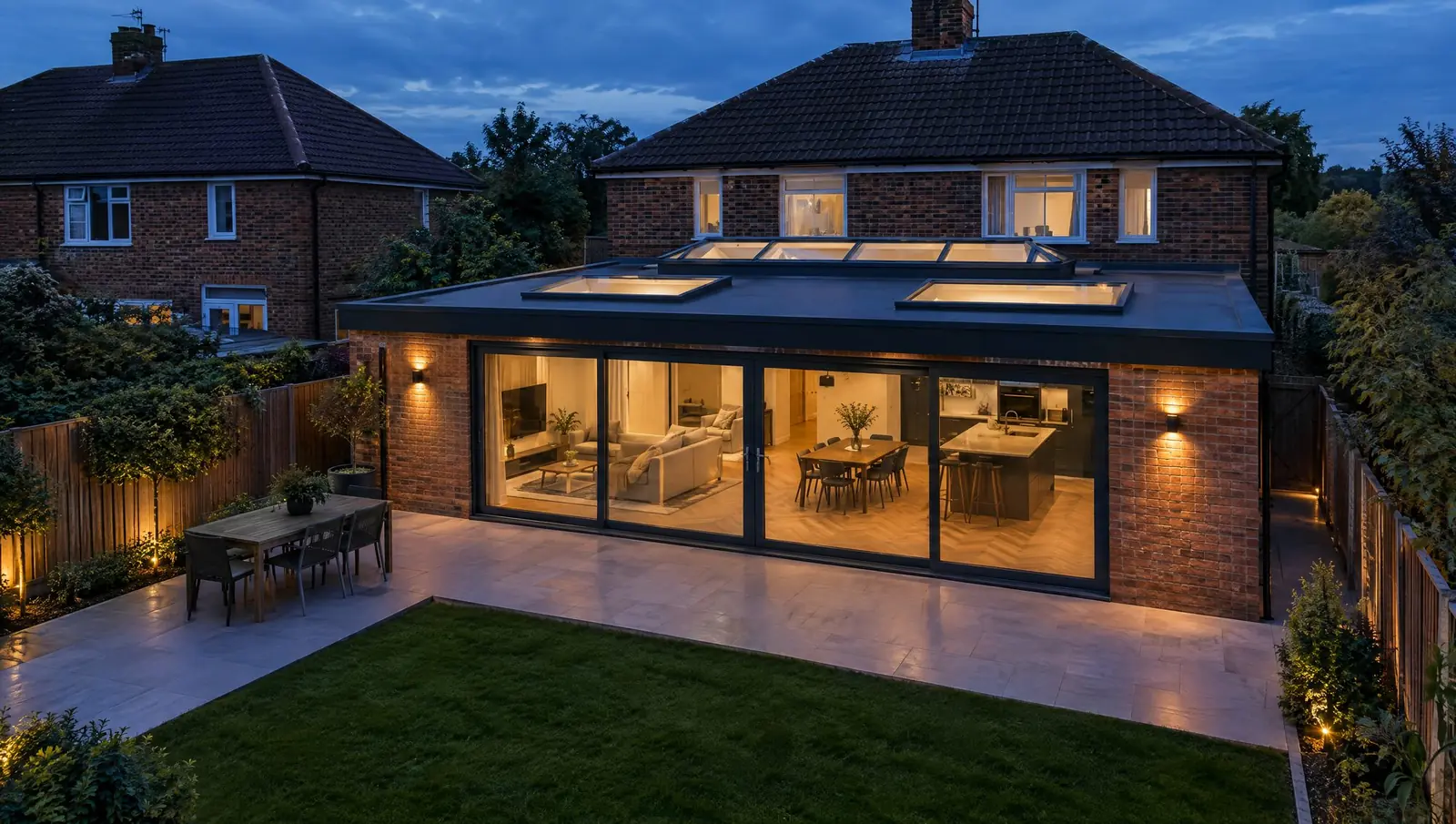
What do flat rooflights in Dover involve?
Thinking about flat rooflights in Dover? The short answer: fixed double or triple glazed rooflights for flat roofs and extensions. The longer answer depends on your roof, which is why we survey before we price.
Period cottages and conservation-area streets are common in the South East, so slim conservation rooflights are often the right choice. Typical uses for flat rooflights include landings, bathrooms and rear extensions with flat roofs.
Jobs in Dover are planned around access: whether the roof can be reached from the garden, whether a hoist or crane is needed, and where we can park. We check this when we measure.
What you can choose
- Plastered or lined internal reveal
- Rain sensor if paired with an opening unit
- Insulated kerb or timber upstand built to suit
- Solar-control or self-cleaning outer pane
- Square, rectangular or long-format sizes
- Double or triple glazed with a warm-edge spacer
- Even, top-down daylight across the whole room
What to check first
- Needs a properly formed upstand — usually at least 150 mm above the finished roof surface (check the manufacturer's figure)
- New openings in an existing roof need a structural check on joists
Do you need permission in Dover?
Most rooflights on English houses do not need planning permission, provided they keep within 150 mm of the roof surface and below the ridge line. A rooflight on a side-facing slope must be obscure-glazed, and fixed shut unless the opening part is more than 1.7 m above the floor.
Under Approved Document L, a rooflight added to an English home must achieve at least 2.2 W/m²K (horizontal plane), and a roof window 1.4 W/m²K or Window Energy Rating Band B. In an extension, glazing including rooflights is normally limited to 25% of the new floor area plus any windows or doors the extension covers, unless a whole-house calculation shows otherwise.
See our building regulations guide for U-values, glazing limits and self-certification.
Guide prices for Dover
These are typical supply-and-fit ranges. For an address in Dover, scaffold, a hoist for heavy glass, or a new structural opening can move the figure, which is why we survey first.
| Option | Guide price inc VAT | Ex VAT |
|---|---|---|
| Large or triple glazed (1500 × 2500 mm and up) | £2,395 – £4,195 | £1,995 – £3,495 |
| Mid-size double glazed (1000 × 2000 mm) Typical | £1,675 – £2,395 | £1,395 – £1,995 |
| Small double glazed (up to 1000 × 1000 mm) | £1,195 – £1,795 | £995 – £1,495 |
How the job runs
- Send the details. Postcode, rough size and a photo of the roof and room.
- Free site visit. For new installs we survey free, measure and confirm the roof detail.
- Written price. You receive a fixed price listing the unit, the work and the lead time.
- Fit and make good. We fit, seal, test and finish the reveal, then hand over the paperwork.
Nearby towns
Related work in Dover
Common questions
Can a flat rooflight be walked on?
Not unless it is designed as a walk-on unit with structural laminated glass. A standard flat rooflight is for light only — if the roof is used as a terrace, choose a walk-on rooflight instead.
How long does it take?
Fitting into a prepared upstand usually takes a day. Forming a new opening in an existing roof, including making good inside, is often two to three days.
Do flat rooflights leak?
A well-fitted flat rooflight should not leak. Leaks almost always come from the upstand or membrane detailing, not the glass unit, which is why the upstand height and the way the roof covering is dressed up and under the frame matter more than the brand.
Is the survey in Dover free?
Yes for new installations. Repair visits are charged, and we tell you the price before we book.
Do I need to be at home for the survey in Dover?
Yes — someone needs to let us into the room below and, where possible, show us how the roof is reached.