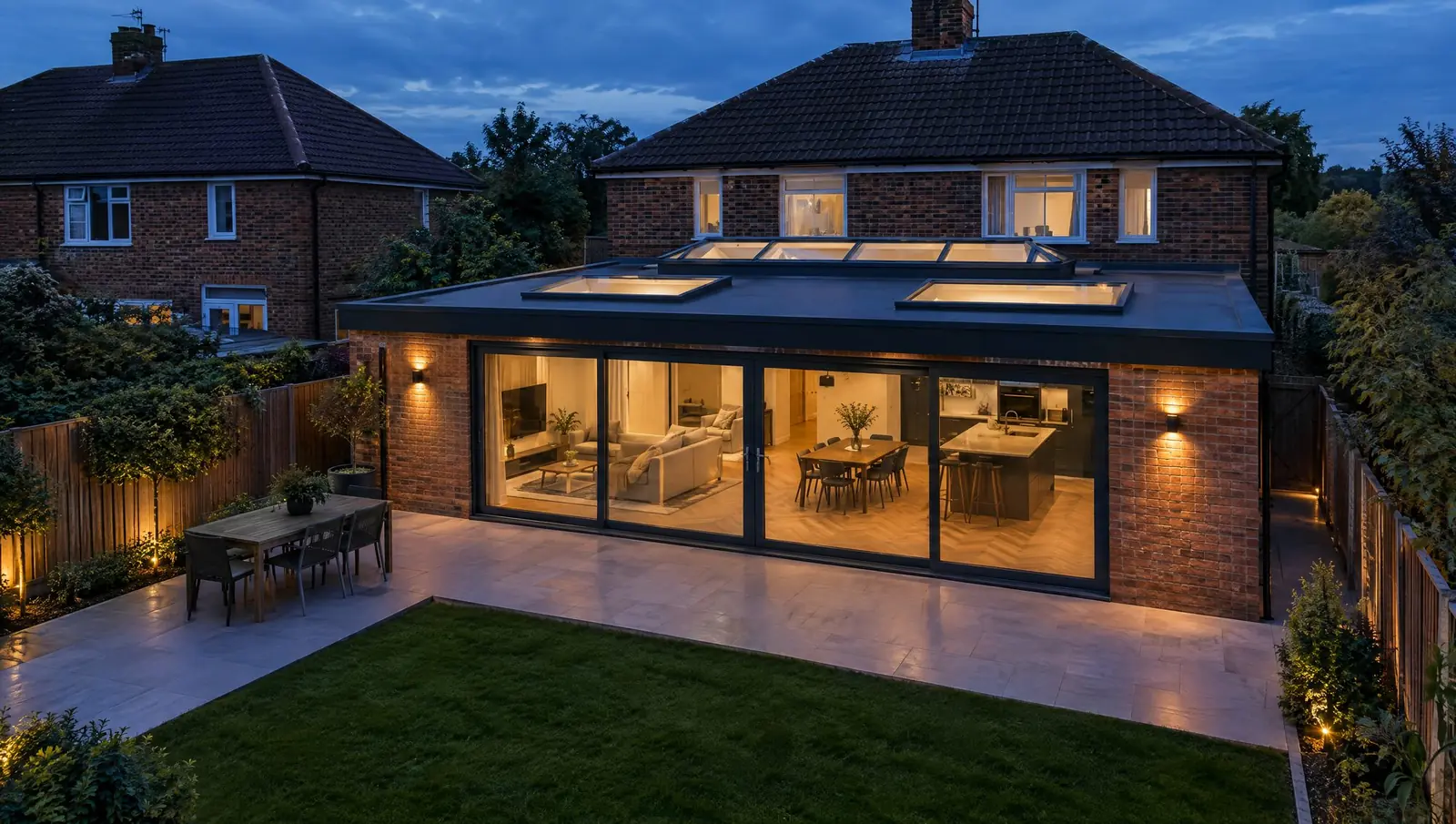
Roof lanterns in March: what is involved?
Our roof lanterns service in March covers hipped glass lanterns that lift the ceiling of orangeries and extensions. Every job starts with a survey of the opening, the roof covering and the room below, and a fixed written price.
Barn conversions and timber-framed homes across the East often call for conservation rooflights or bespoke glass. In March, as anywhere, roof lanterns are the usual choice for rooms that need height as well as light.
March is around 23 km from Peterborough, and we survey and fit throughout that part of Cambridgeshire, including the PE15 district.
Specification options
- LED lighting in the plaster box
- Opening vents with electric control
- Internal and external colours
- Rectangular, square or bespoke sizes
- Solar-control or self-cleaning glass
- Slim aluminium bars, more glass
- Light from every angle across the day
Things we check at survey
- Larger lanterns may need a steel or timber ring beam
- Some designs project above the roof enough to affect planning on certain houses
Planning, building control and March
Most rooflights on English houses do not need planning permission, provided they keep within 150 mm of the roof surface and below the ridge line. A rooflight on a side-facing slope must be obscure-glazed, and fixed shut unless the opening part is more than 1.7 m above the floor.
Building Regulations Approved Document L sets a limiting U-value of 2.2 W/m²K for new or replacement rooflights in existing homes, measured in the horizontal plane; roof windows need 1.4 W/m²K or a Band B energy rating. In an extension, glazing including rooflights is normally limited to 25% of the new floor area plus any windows or doors the extension covers, unless a whole-house calculation shows otherwise.
Our planning guide covers each nation in more detail.
Roof lanterns prices in March
Prices below are shown including and excluding VAT. In March, as elsewhere, making good inside and access equipment are the main variables.
| Option | Guide price inc VAT | Ex VAT |
|---|---|---|
| Large or bespoke aluminium lantern | £5,995 – £10,795 | £4,995 – £8,995 |
| Mid-size aluminium lantern (2 × 3 m) Typical | £3,955 – £5,995 | £3,295 – £4,995 |
| Small lantern (1 × 2 m) | £2,995 – £3,955 | £2,495 – £3,295 |
From enquiry to finished job
- Send the details. Postcode, rough size and a photo of the roof and room.
- Measure and check. A surveyor visits March, measures and checks structure and access.
- Fixed quote. Product, work and price in writing — nothing is ordered until you agree.
- Fit and make good. We fit, seal, test and finish the reveal, then hand over the paperwork.
Neighbouring towns
Related work in March
Questions about roof lanterns in March
Roof lantern or flat rooflight?
A lantern adds height and sky from all sides; a flat rooflight is lower-profile and cleaner from outside. Our guide compares them in detail.
How big can a lantern be?
Aluminium systems go to around three by six metres in standard ranges; larger sizes are made to order.
Aluminium or uPVC?
Aluminium gives slimmer bars and a longer life; uPVC costs less. We fit both.
Can you work alongside my builder in March?
Yes. On new extensions we fit once the opening and upstand are ready and coordinate dates with your builder.
Do I need to be at home for the survey in March?
Yes — someone needs to let us into the room below and, where possible, show us how the roof is reached.